



Part 3: Six Months In, Elliot Has Reached China
The Pamir Highway is behind him. So are a broken pedal, two bouts of stomach illness, a 5,100-metre summit and the Tunnel of Death. When I caught up with Elliot, he was in a hotel in Urumqi, in the corner of China that lies farther from the sea than anywhere else on Earth, working out how to cross the biggest country on his road to Australia.
When I last spoke to Elliot, he was in Dushanbe, about to ride into the Pamir Mountains with a new inflatable sleeping mat and a stomach that had only just recovered.
Seven weeks later, I found him in Urumqi, a city of around four million in the far north-west of China. Most of us had never heard of it. Funnily enough, though, a man at Elliot’s hotel had heard of the Swedish football club Hammarby. He bets on their matches. God knows why.
Between the two calls: three weeks on the Pamir Highway, two weeks through Kyrgyzstan, two days across a corner of Kazakhstan, and around 700 kilometres of China, which sounds like a lot until you look at how much of China is still ahead.
Last time, the Pamir Highway was something he was preparing for. Now it is something he has stories about.
And there are quite a few. The first actually comes from before our last call, and never made it into Part 2. Elliot calls it “a fun introduction to Tajikistan”. I would have chosen other words.
The journey through the Hissar Range
To get from Samarkand to Dushanbe, Elliot first had to cross the Hissar Range.
His preferred route was the old road over the mountains, across the Anzob Pass, a high crossing whose name may reach back to the Sogdian world of the ancient Silk Road.
Before the tunnel was built, this was the main direct route across the Hissar Range between southern and northern Tajikistan. It is not an easy one. The road is narrow, winding and rough, and for much of the year snow makes the pass impassable.
Still, to Elliot, it seemed considerably more appealing than the alternative.
That alternative disappeared under the mountain.
The five-kilometre Anzob Tunnel opened, half-finished, in March 2006 and quickly earned the nickname “Tunnel of Death”. In its early years, poor ventilation, darkness, flooding, heavy exhaust fumes and the lack of a central barrier made the crossing notorious, and deadly.
So Elliot chose the freedom of the mountain.
He began climbing towards the pass, only to be stopped partway up by two road workers. He was told the road was closed, and nobody could explain why.
He now had but one choice.
He had to face the long dark of the Anzob Tunnel.
Conditions inside have improved since the tunnel’s early years, but it still has a reputation as one of the world’s most dangerous tunnels. For Elliot, that hardly made the prospect more inviting.
But Elliot turned around, descended back to the main road and rode into the mountain.
Five kilometres of darkness, fog and broken road followed.
For most of it, there was little more than Elliot, his bicycle and the small world illuminated by his bike light. He would later admit he was not entirely sure riding through the tunnel had been a sensible idea.
I’m alive and I got through it.
And I am very glad he did, without the sound of drums in the deep, or demons in the dark.
The legendary Pamir Highway
Before Elliot set out, the Pamir Highway was not a fixed part of the route. He knew of it, but only vaguely. The closer he got, the more stories he heard, and eventually it became one of those ideas that are much easier to add to a route than to remove from your head.
He did not choose the easy version either. Two rougher alternatives took him away from the main road, the M41, and deeper into the mountains. And the Pamirs do not tend to let anyone pass through without leaving a mark.
I asked him how it was.
It was an experience. It is quite hard to explain.
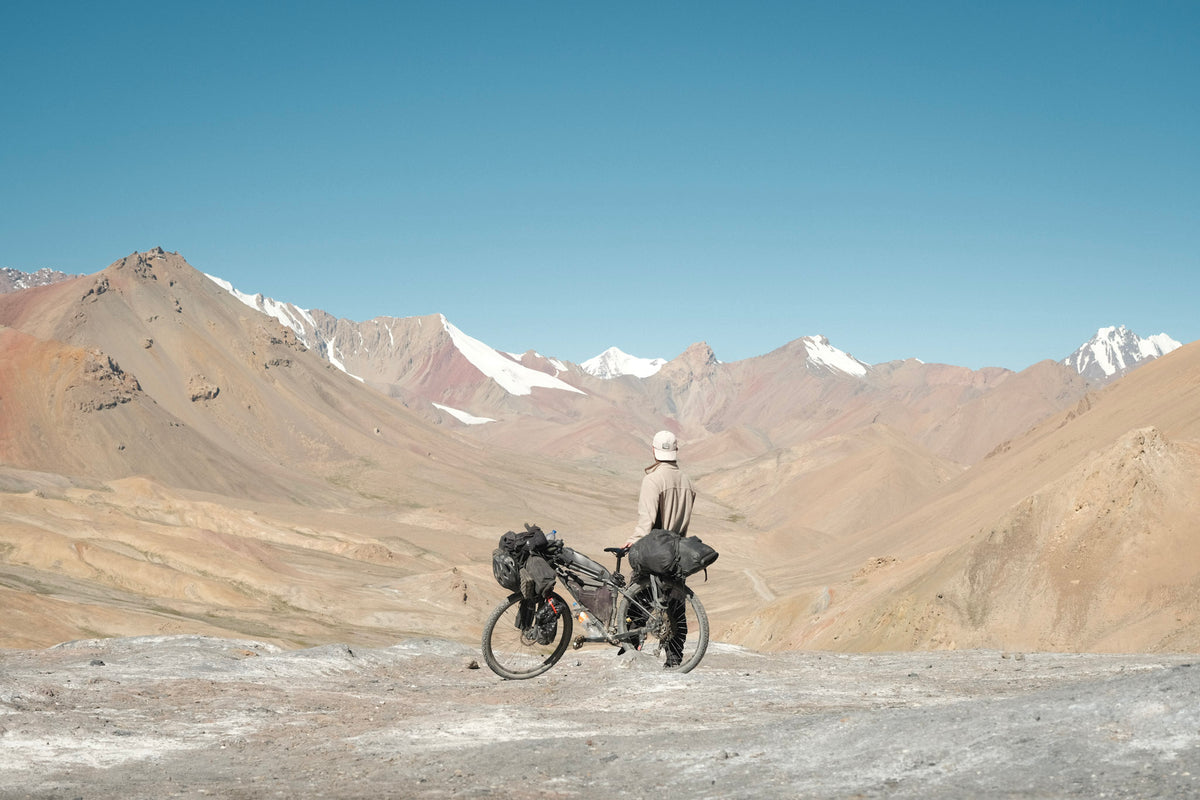
He tried anyway. The road climbs gradually, from around 800 metres to a high plateau at 4,000, and then over the Ak-Baital pass at 4,655 metres, the highest point Elliot has ever cycled. Around it: enormous mountains, lakes and rivers, in a landscape as empty as it is beautiful. The region, Gorno-Badakhshan, is very poor. People live simply, and food is basic and hard to find. For a vegetarian, harder still.
It’s the extreme of everything.
A very French start to the mountains
Elliot did not ride into the Pamirs alone. He left Dushanbe with a group of French cyclists. More joined along the way, and for part of the first week he found himself riding with eight of them.
A few days out of Dushanbe came the first of the rougher alternatives. On a 3,000-metre pass, with seven kilometres left to the top, one of his pedals snapped off. The metal itself broke. The pedals had been replaced in Samarkand and, as it turned out, not with good ones.
There was nothing for it but hike-a-bike, as Elliot calls it: the last seven kilometres to the top on foot, in the evening, pushing a loaded bicycle.
At the top waited a small hut, the kind you find in the Norwegian mountains, a spectacular view, and the French. Below waited 35 kilometres of loose gravel and stones, to be ridden with one pedal, trying not to break a leg. He had never done anything like it before, and says he never will again.
It was not the last time he walked. On the steepest climbs, eight or ten per cent over loose gravel, the rear wheel simply spun, however low the gear. Once, the road was so broken that even going downhill meant getting off.
Then his stomach joined in. Elliot was ill twice. The worst days came along the Afghan border: bad roads, a bad stomach, and 160 kilometres to the next town with a hotel. He ranks them level with the week of 45 to 48 degrees in Kazakhstan and Uzbekistan as the hardest of the whole journey.
Nobody got off lightly. Everyone he met up there seemed to be dealing with something: a bad stomach, altitude sickness or bike trouble, and sometimes all three. The group thinned out, as groups do, with different routes, different speeds and different problems. Two of the French riders followed Elliot onto the second of his rougher alternatives. Three days later, both had mechanical problems, bad stomachs and altitude sickness, and they took a taxi through the rest of Tajikistan.
The same mountains produce rather different journeys.
Elliot rode the last week and a half alone.
Marx, Engels and 5,100 metres on foot
That second alternative meant three days with nowhere to buy food, and he chose it partly for the view: it passes Karl Marx Peak and Engels Peak, both well over 6,000 metres. He also saw Lenin Peak, above 7,000. Somebody, at some point, clearly had a theme.
And at one point he left the bike and walked up a 5,100-metre summit, the highest he has ever stood. Seven kilometres, 700 metres of climbing, loose gravel, and a final 200 metres closer to scrambling than hiking. Wind, because nothing around it blocks the wind. Thin air, so you stop often to breathe.
He was alone. He had read that it could be done, and he had the coordinates of the top. Had he not known that others had made it up, he says, he would have turned back.
That was probably the time I felt the most adrenaline in my body.
From the summit, snow-capped mountains in every direction, some of them with peaks rising above 7,000 metres.
Scary, but a lot of fun.
Then, at the Kyrgyz border, the reward: around 200 kilometres of descent, from about 4,000 metres down to 800.
A nice downhill.
Would he recommend it?
I recommend it. You just have to know what you’re getting into.
From my end of the call, it is dangerously easy to be inspired. But I’m not the one pushing a loaded bicycle uphill with a stomach bug. Elliot himself would probably not ride it again. In some years, maybe, with a jeep, to spend more time hiking and climbing. But he does not regret a metre of it. Three weeks, he says, that feel like far more.
What the cold said about the sleeping mat
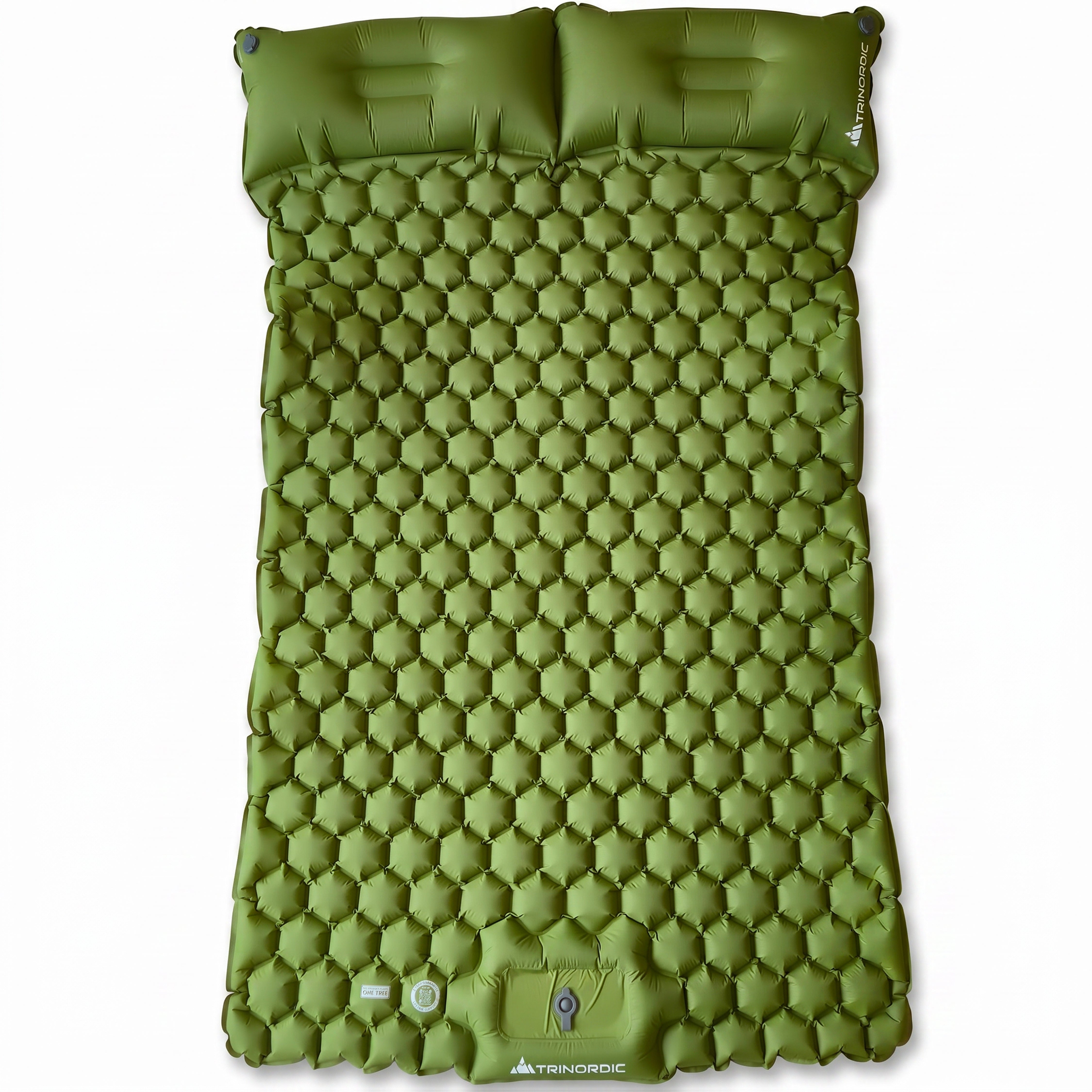
In Part 2, Elliot had just been handed a new, insulated Trinordic sleeping mat by his father in Samarkand. In the Uzbek heat, it stayed packed. The Pamirs were its first real test.
Up in the mountains, a couple of nights dropped below zero.
Two or three evenings he arrived late and tired, skipped dinner, skipped inflating the mat, and went to bed on his regular foam pad. Each time he woke up cold in the middle of the night and inflated the mat after all. This way he could still get a good night’s sleep on the hard and cold ground.
His verdict: where nights get that cold, an insulated mat is as necessary as a warm sleeping bag. At lower elevations, it is more of a comfort you can choose.
There are still a few 3,000- to 4,000-metre passes between him and Southeast Asia, and autumn is coming.
The mat stays.
Into China
After four or five days in Osh, eating properly and repairing everything a month of bad roads had broken, Elliot rode on through Kyrgyzstan and a corner of Kazakhstan to the Chinese border.
China arrived as a shock, in the good sense. After Tajikistan, Elliot calls it the most developed country he has ever visited. The roads are excellent everywhere, Urumqi is spotless, and he has phone coverage at 3,000 metres in the mountains, which is more than some of us get at home. Western apps need a VPN, and cash and cards have given way to QR codes. The police are the friendliest he has met anywhere, and occasionally keen on a photo with him.
The next challenge is time.
His visa-free stay is not long enough to cycle all the way through China in one go, so the first target is Xining. For the next three weeks, Elliot plans to average around 130 kilometres a day, crossing the Gobi and heading east towards the centre of the country.
In Xining, he hopes to extend his stay. After that, the plan is to turn south, slow down and make his way through the more densely populated heart of China towards Vietnam. From Xining, the border is just under 3,000 kilometres away, depending on the route he takes. At some point, he may need to take a train to Hong Kong or Macau, leave mainland China and re-enter to reset the clock.
He is also looking forward to seeing the sea again.
The simple part
After four or five months on the road, he says, you cross a threshold. Everything that could go wrong has already gone wrong once. So when it happens again, on a 3,000-metre pass with one pedal, you can take it quite calmly. In the moment, he says, that is what he did.
You can do more than you think.
The months of routine are part of why he went looking for something harder in the Pamirs. But the routine has its own charm.
It’s a very simple way to travel. You just do the same thing.
Next time we speak, he will be near the end of China, or already in Hanoi. The road goes ever on.
Follow Elliot’s journey here on the Trinordic Journal and on Instagram at @elliotphilip_.